On this page
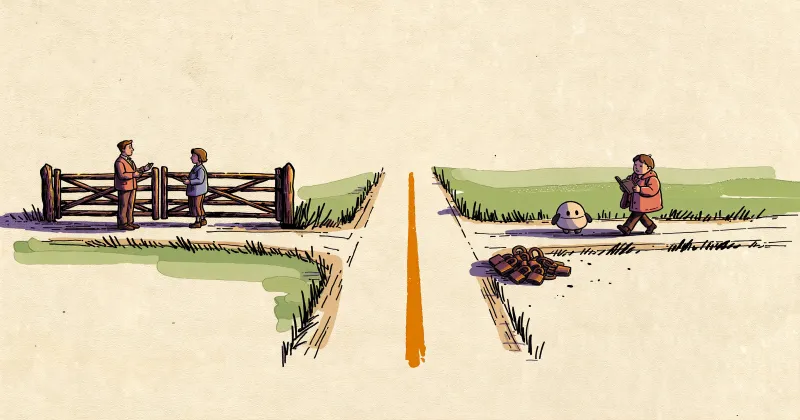
Whether a PSRB treats your online degree as a variant of an accredited programme or as a new one decides the evidence, the timeline and the risk. It is often settled by details teams don't think of as changes.
In the first article in this series, I introduced the Online Accreditation Guide, a practical guide to taking online degrees through accreditation with professional, statutory and regulatory bodies (PSRBs). This article examines the question that comes before everything else: is your online programme an extension of an existing accreditation, or a new submission?
Teams often treat it as paperwork, but the answer determines what the PSRB will test, how much evidence you need, how long the process takes, and what can go wrong. If you assume too little, you may be asked for a full review late in the cycle, when your launch date is already advertised; if you assume too much, you may spend months on documentation the PSRB never needed.
Two routes, two different tests
Extending an accreditation fits when the online programme shares the award title, learning outcomes and assessment strategy of an accredited on-campus programme, and delivery mode is the main change. What the PSRB tests is equivalence: do online students reach the same outcomes to the same standard? The typical evidence is module mapping, the delivery and support model, staffing, assessment security and the student experience. The main risk is assuming that the differences are too small to matter.
A new submission fits when there is a new award, different outcomes or structure, no existing accredited programme, or a different delivery partner. Here the PSRB reviews the whole programme against its standards. Expect full documentation, competency mapping, resources, staffing and quality processes, and often a visit. The main risk is underestimating the lead time and the amount of mapping involved.
Neither route is easier than the other. An extension asks a narrower question, but asks it searchingly: the panel will look hard at every way the online version differs from its parent. A new submission asks a broader question, but on your own terms, without an existing programme to be compared against.
Hidden divergence
The difficulty is that online versions drift from their parent programmes in ways teams do not always recognise as changes. The guide lists the common ones:
- Different module sizes, often to fit shorter study blocks for part-time learners.
- Multiple intakes a year, which change progression routes, exam board patterns and staffing.
- Shorter teaching blocks, which compress the same content into a different rhythm.
- A partner delivering support, such as an online programme manager (OPM) handling student services, tutor recruitment or marketing.
- A different assessment mix, often because in-person exams can't run in the same way online, or because the online team has redesigned assessment in response to generative AI.
Each of these can tip an extension into a new submission. Individually, each looks like an operational decision made for good reasons. Together, they can produce a programme that shares a title with the accredited programme but is, in the PSRB's eyes, something different.
Assessment is the difference I expect to come up most often over the next year. Earlier this month the Office for Students and Advance HE published their report on AI in higher education, alongside OfS guidance that each assessment must be valid and reliable, and that secure assessment methods should be used where they are necessary (OfS, 2026a, reference, 2026b, reference). I looked at what the report means for online and partnership delivery when it came out, but accredited programmes have an extra consideration, which the report itself recognises: PSRBs may prescribe particular assessment approaches, or require institutions to seek their approval before changing them (OfS, 2026a, reference, para. 59).
If your online version replaces the existing on-campus programme's exams with live online vivas, or adds process-based checkpoints that the campus version doesn't have, you have changed the assessment strategy, which is one of the things an extension assumes stays the same. Some participants in the research felt that PSRB requirements had slowed their institution's response to AI on accredited courses, though the report also suggests that the high standards some PSRBs set may have helped keep assessment effective (OfS, 2026a, reference, para. 121). Either way, it belongs on your list of differences.
Don't forget academic and pastoral support
Academic support from tutors and pastoral support from advisers may mirror what on-campus students receive, but if the responsibilities or mechanisms differ, the PSRB may treat this as a significant difference from the existing programme.
The guide's advice is to list every difference before you approach the PSRB, including the ones you think are minor, because a complete list protects you either way. If the PSRB says the differences are minor, you have that in writing, and if it says they are not, you have found out at the start rather than at the panel, when extra work could delay the launch.
Check what the accreditation actually covers
An additional concern is the wording of an existing accreditation. Some accreditations name the mode, location or cohort they apply to; if yours names on-campus delivery, an online cohort is not covered until the PSRB says so.
The wording matters beyond the submission itself, because students need accurate information about accredited status from the point of offer. If a prospective student reads that "the programme is accredited" and later finds out that only the on-campus version is, they have a reasonable complaint, and the institution has a reputational problem. Accreditation status wording therefore needs to be agreed before the first advert goes out, which is one reason the route question has to be settled so early.
The same timing applies to assessment. The OfS report notes that where a provider has committed to assessing a module in a particular way before students sign their contracts, it may need to consult them before making changes (OfS, 2026a, reference, para. 122). If the PSRB is likely to want changes to your assessment strategy, it is much easier to find out before the course information is published than after the first cohort has enrolled.
Five questions to take to the PSRB
The guide's route finder asks five questions:
- Is there an accredited on-campus version of this programme?
- Will the online version have the same award title?
- Are the learning outcomes identical?
- Are module sizes, structure and assessment strategy unchanged?
- Will a partner or online programme manager deliver teaching or support?
If the answers are yes, yes, yes, yes and no, you are probably looking at an extension of the existing accreditation. Any other combination points towards a new submission, or at least towards a conversation in which the PSRB will want to understand the differences in detail.
The route finder can only give an indication, since the decision belongs to the PSRB. Its value is in helping you frame the conversation, so that you approach the PSRB with a clear account of what is the same, what is different, and why, rather than a general enquiry.
Ask in writing, and keep the reply
The single most useful step is to write to the PSRB before planning anything else. Set out the online programme, the accredited programme it is based on (if there is one), and your list of differences, then ask which route applies and what evidence the PSRB expects. The same message can cover submission windows and fees.
Keep the reply, because you will quote it to faculty management when you make the internal case, and it turns an abstract risk into specific requirements. In the guide's seven-stage approach, a written confirmation of the route is the first gate: detailed mapping should not start until you have it.
Frame the case around outcomes
Whichever route applies, the strongest submissions argue for equivalent outcomes instead of defending the online format.
The evidence supports that framing: the Office for Students' (2022), reference review of blended learning found both high- and low-quality teaching in face-to-face and online modes, with staff capability a bigger factor than the mode of delivery. Topping's (2023), reference review of online and face-to-face peer learning found online approaches at least as effective for learning outcomes, but long-term evidence remains limited.
For an extension, this means showing that online students reach the same outcomes to the same standard, and explaining each difference in delivery in terms of how it supports those outcomes. For a new submission, it means designing the programme around the PSRB's competencies from the start, then showing where each one is developed and assessed. In both cases, the panel's question is the same: how do you know an online graduate meets the standard? Since the OfS published its guidance, I would also expect panels to ask how you know the work was the student's own, and for an online programme that means being able to show where the secure assessment points sit.
Making the route decision explicit
In the guide's decision planner, the route is the first of eight decisions, owned by the programme lead with the faculty quality lead. There are three options: extension of an existing accreditation, new submission, or seeking PSRB guidance first. The third is a legitimate choice when the differences are genuinely ambiguous, since recording that you are waiting for the PSRB's view is better than guessing.
Whatever you decide, document who made the decision, when and why. When the submission comes to be written, that record becomes the opening of your narrative: here is the programme, here is how it relates to what is already accredited, and here is the PSRB's own confirmation of the route.
Next in this series
Once the route has been identified, the hardest questions are often about practical competencies. In the next article in this series, I will look at how labs, simulations and other online activities can replace the in-person practical.
References
- Office for Students (OfS). (2022). Blended learning review: Report of the OfS-appointed Blended Learning Review Panel. https://www.officeforstudents.org.uk/media/7626/blended-learning-review-panel-report.pdf
- Office for Students (OfS). (2026a). Making AI work for students: Reflections on institutional practice (OfS 2026.56). https://www.officeforstudents.org.uk/publications/making-ai-work-for-students-reflections-on-institutional-practice/
- Office for Students (OfS). (2026b). Effective institutional practice in AI. https://www.officeforstudents.org.uk/for-providers/quality-and-standards/artificial-intelligence-in-higher-education/effective-institutional-practice/
- Topping, K. J. (2023). Advantages and disadvantages of online and face-to-face peer learning in higher education: A review. Education Sciences, 13(4), 326. https://doi.org/10.3390/educsci13040326
Cite this article
Muirhead, J. (2026, November 23). Extension or new submission? The first question in online accreditation. jessica.digital. https://jessica.digital/articles/accreditation-extension-or-new-submission
Muirhead, J. (2026) 'Extension or new submission? The first question in online accreditation', jessica.digital, 23 November. Available at: https://jessica.digital/articles/accreditation-extension-or-new-submission (Accessed: 23 November 2026).
J. Muirhead, “Extension or new submission? The first question in online accreditation,” jessica.digital, Nov. 23, 2026. [Online]. Available: https://jessica.digital/articles/accreditation-extension-or-new-submission (accessed Nov. 23, 2026).
@misc{muirhead2026accreditation,
  author       = {Muirhead, Jessica},
  title        = {{Extension or new submission? The first question in online accreditation}},
  howpublished = {jessica.digital},
  year         = {2026},
  month        = nov,
  url          = {https://jessica.digital/articles/accreditation-extension-or-new-submission},
  note         = {Accessed: 2026-11-23}
}