Self‑diagnostic Study Skills tool for online PGT students
As I prepare to share our work-in-progress poster, "Self‑diagnostic Study Skills tool for online PGT students," at the forthcoming University of Hull Teaching & Learning Conference, I have been reflecting on the architectural and pedagogical design choices that underpin this intervention.
This project represents a direct, scalable continuation of our earlier Study Skills work (Muirhead & Dale, 2025). For me, it also marks a deliberate application of my broader research interests: bridging the gap between rigorous Information Systems design, cognitive usability, and human-centric digital pedagogy.
The Pedagogical Imperative: Fragmented Academic Identities
In the taught postgraduate (PGT) sector, online, part-time distance learners represent a distinct student typology. They are overwhelmingly mature, time-poor, professionally diverse, and balancing intense external responsibilities.
Wider UK research consistently highlights that mature students frequently enter postgraduate study encountering distinct confidence barriers, shifting professional-to-academic identities, and severe cognitive load challenges (Jones & McConnell, 2023; Gongadze et al., 2021).
Within the Hull Online portfolio, these challenges manifest explicitly across the student lifecycle: to combat asynchronous isolation, our learning environments must be intentionally scaffolded to support self-direction and metacognitive growth.
The Framework: Evaluating Competence and Usability
Rather than offering generic, passive study skills repositories, our intervention centers on a digital self-diagnostic tool. The design logic is rooted in an empirical eight-domain framework derived from our initial pilot data:
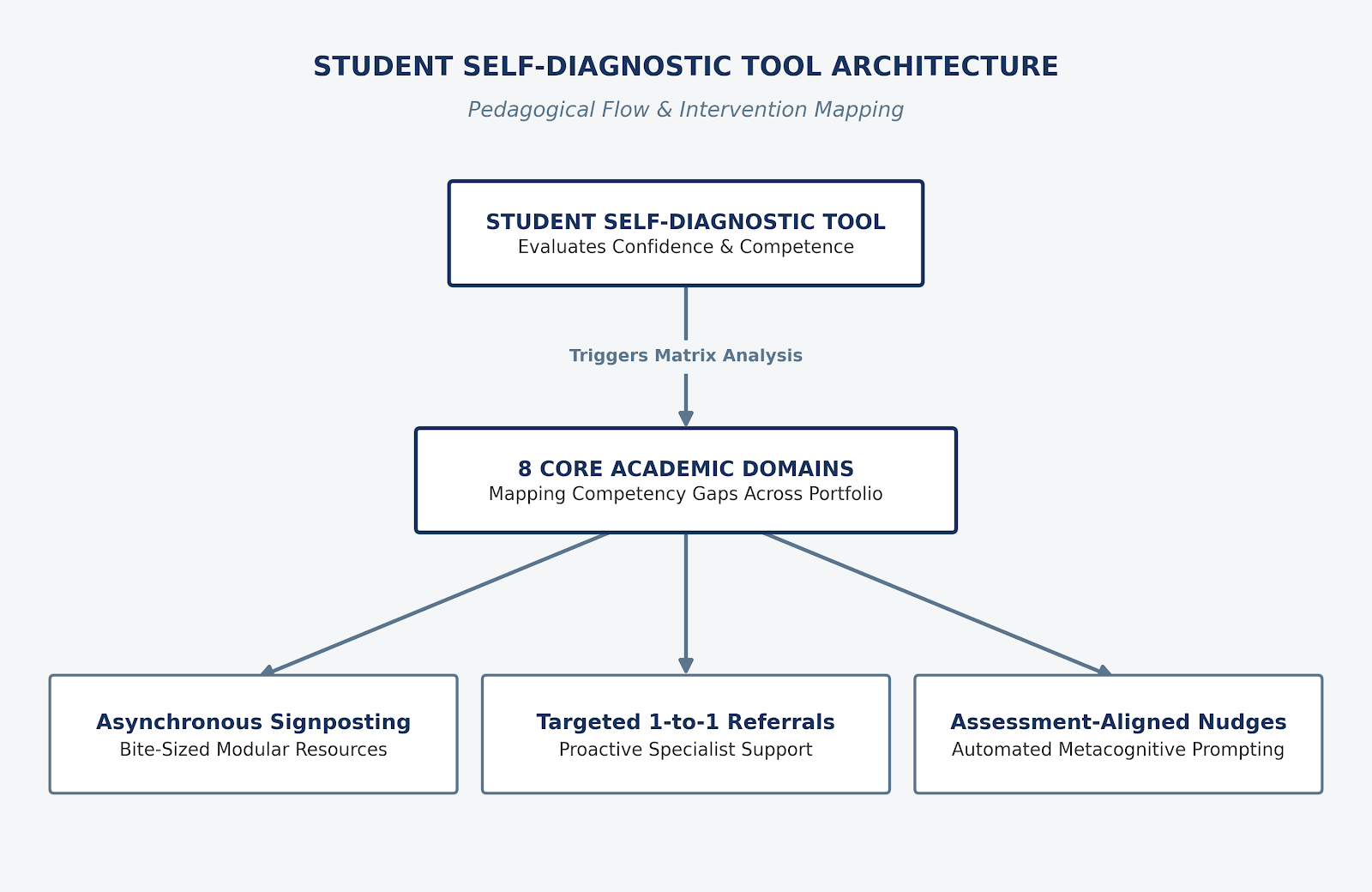
The diagnostic architecture prompts students to self-evaluate both their confidence and competence across these specific academic and affective spaces:
Academic & Critical Rigour: Academic writing, critical thinking, referencing, reflection, and avoiding plagiarism.
Operational & Resilience: Presentations, time management & goal-setting, and stress management & self-care.
Once user input is captured, the system bypasses standard information noise to engineer a personalised recommendation pathway. This signposts the learner to bite-sized asynchronous resources, initiates direct referrals to targeted 1-to-1 support, or triggers assessment-aligned interventions.
Alignment with Adaptive Learning Architectures
This emphasis on personalisation aligns heavily with current sector evaluations of adaptive EdTech and emerging generative AI tools. When applied ethically and within a sound pedagogical framework, automated, adaptive feedback loops have been shown to significantly strengthen cognitive, technical, and metacognitive skills by coaching students to systematically identify and respond to their own developmental deficits (Daniel et al., 2025).
Methodology & Early Evaluation Outcomes
To understand the efficacy of the tool, we have undertaken a pilot deployment with an initial cohort of online PGT students, utilizing a mixed-methods evaluation strategy.
Quantitative Metrics: Our analysis evaluates tool-use analytics, domain-level confidence tracking, and the downstream uptake of recommended micro-interventions.
Qualitative Metrics: Through post-use surveys and voluntary semi-structured interviews, we are exploring student perceptions of platform usability, curriculum relevance, and perceived impact on assessment preparedness.
Emerging Findings: Early evaluations suggest that the diagnostic tool is effective in surfacing hidden or unmet academic study skills needs. In asynchronous distance learning, mature students often mask support needs until a critical assessment checkpoint. This tool forces a soft, early diagnostic intervention.
Sector Engagement: An Invitation for Feedback
As this remains a work-in-progress project, our primary objective at the conference is to open up our framework to peer review. We are actively seeking dialogue with other researchers and practitioners on three critical areas:
Framework Validity: Does an eight-domain diagnostic taxonomy comprehensively map the fluid academic realities of modern postgraduate learners?
Learning Analytics Infrastructure: What are the operational opportunities and systemic risks of embedding this tool within wider university data architectures to drive early, automated institutional interventions?
Engagement Mechanics: What behavioral or pedagogical strategies are most effective at sustaining long-term engagement with self-directed diagnostic tools within fragmented, asynchronous cohorts?
Ultimately, this project seeks to contribute to ongoing sector conversations around how we build scalable, equitable, and highly personalised academic support systems that harness emerging technology to serve genuine pedagogy.
Join us at the Hull Online Poster Session
If you are attending the University of Hull Teaching & Learning Conference in July 2026, my colleague and I welcome you to visit our poster and discuss these design challenges within the online space. If you are unable to attend, I invite you to connect with me via LinkedIn to share your perspective on postgraduate digital learning architecture.
References
Daniel, K., Msambwa, M. M., & Wen, Z. (2025). Can generative AI revolutionise academic skills development in higher education? A systematic literature review. European Journal of Education, 60(1).
Gongadze, S., Styrnol, M., & Hume, S. (2021). Supporting access and student success for mature learners. Transforming Access and Student Outcomes (TASO).
Jones, J., & McConnell, C. (2023). Changing mindsets and becoming gritty: Mature students’ learning experiences in a UK university and beyond. Innovations in Education and Teaching International, 60(6), pp.883–893.
Muirhead, J. & Dale, L. (2025). Enhancing study skills for online postgraduate students: an interventionary approach. Presented at the University of Hull Teaching and Learning Conference.